
Magnolia
The Oaks
Lydia Hiorns | Homing
Lydia Hiorn’s activities explore embodied hospitality. She is Director of Shieldfield Art Works (SAW) in Newcastle, operating on the intersection of contemporary art, theological reflection and community activism. Lydia facilitated the collaborative co-creation of the SAW community garden; she practices printmaking and drawing; she is writing a collaborative musical album called “The Arboretum”; and this year in her spare time she made her own wedding dress.
Why does this piece mean ‘homing’ to you? How does it resemble your relationship to place?
I have recently gotten married and we decided to change our surname to Oak. These are the simple linocuts I made to invite friends and family to our wedding, picturing an oak tree and an oak leaf. We picked Oak for many reasons, but the main one was that we want to live wide and deep.
Oaks support more life than any other UK native tree. They are a haven for a colossal 2,300 wildlife species, a homing beacon to many—they nurture, they welcome, they live wide. There are also Biblical stories of a man called Abraham welcoming strangers to eat with them under the Oaks of Mamre, Jacob burying his idols beneath the Oak at Shechem and Isaiah describing the Oaks of righteousness who are in right relationship with God; they go deep in relationship with people, with understanding themselves and in relationship with God. To live wide and deep, that is the home that we are seeking to foster as the Oaks.
Is this piece similar to what you’ve made in the past? How do your materials reflect the place you were representing?
I’ve previously worked in woodcuts and monoprints but have rarely done linocut. I managed to buy a reasonably priced pack of lino and a few packs of cheap lino tools that I am using to help friends to get into art who don’t think they are artsy. The idea of “The Oaks” prints came whilst enjoying an evening linocutting with one such friend. I also needed it to be rather simple to print and register as I was hand-printing over 150 invites. So I guess in the context of mass production, to enable lots of people to come and find out our new name, printmaking is the best form, and it represents us living widely.
As an artist, how has your relationship to place changed? Do you see a place differently after making art inspired by it?
I now can’t help thinking of living wide and deep whenever I see an oak tree or leaf. And there are a lot of oaks in England! In changing one's name, writing a song about an oak tree and making art about it, I feel I am helping myself to remember to live in this way. Whenever I visit a friend’s house who has framed our wedding invitations, it reminds me how to do so with them.
______________________________________
Magnolia
Why does this piece mean ‘homing’ to you? How does it resemble your relationship to place?
Most rentals in the UK are painted in the shade ‘magnolia,’ that exciting yellowy-white that won’t commit to being white or yellow, and thus serving as a backdrop for any tenant's belongings. Rental beige: the symbol of transitory, temporary or volatile housing.
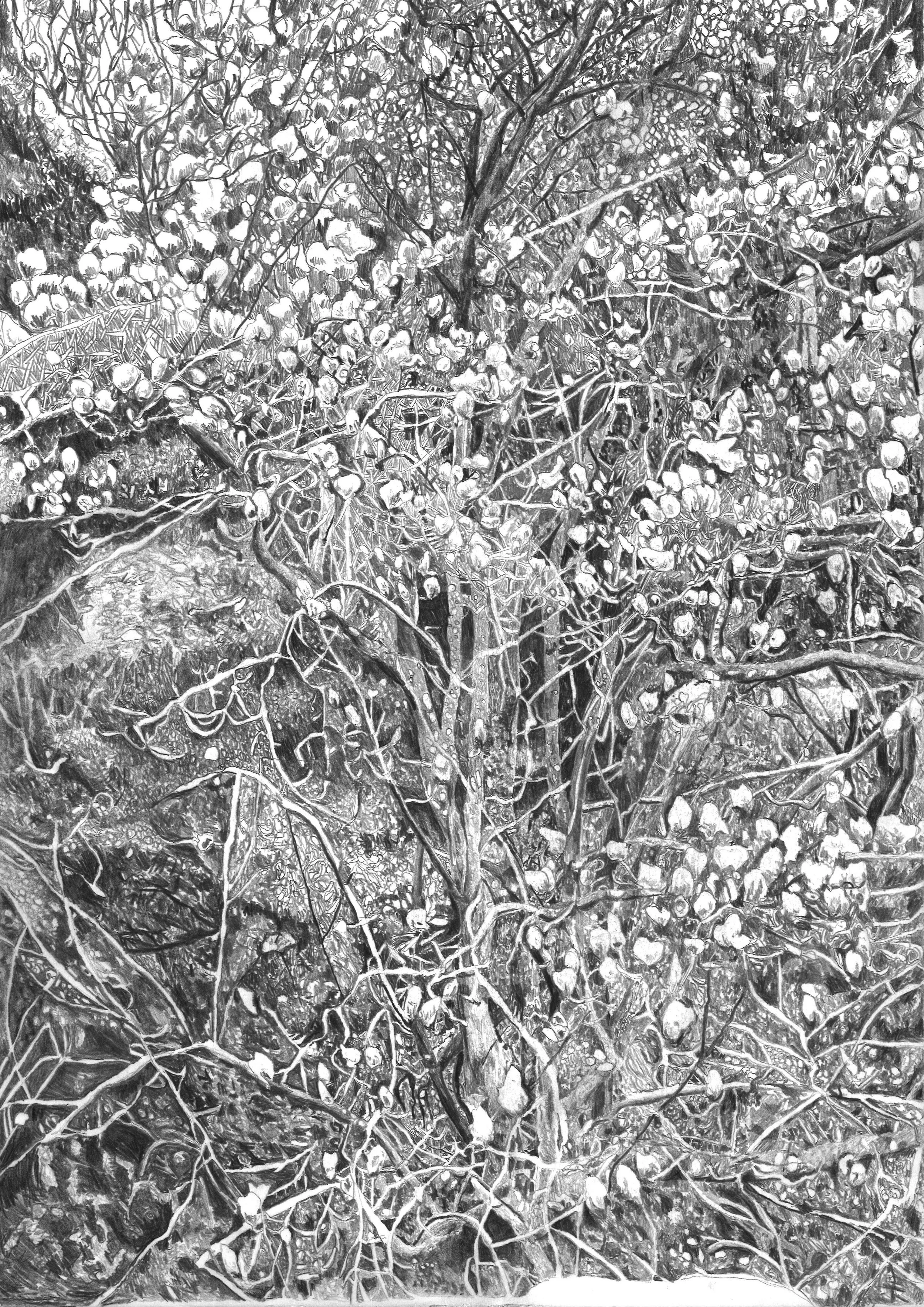
Magnolia also reminds me of home in a different way. The flower of the Magnolia tree has magnificent cup-shaped flowers. They appear on stark bare branches from velveteen buds as the garden begins to stir in spring, as winter’s patience blooms. Each season, when I look at the flowers, I am reminded of Psalm 16, where God is described as ‘you alone are my portion and my cup; you make my lot secure.’ He is the source of ultimate blessing, belonging, rest and inheritance. That is the home to which I seek to return. This is the gift of home—a place of intrinsic belonging, of a rest that does not grow weary, of the blessing of that rightly-needed overflow of the soul. Magnolia blooms: the symbol of a permanent, enduring and stable home.
Is this piece similar to what you’ve made in the past? How do your materials reflect the place you were representing?
I’m currently writing an album called “The Arboretum” in which each song is about a different tree and has a corresponding drawn tree; Magnolia is one of them. I have either photographed trees known to me or found images of others which are too far away for me to visit. This is drawn from a photograph of a Magnolia tree I found in Howick Hall arboretum, in Northumberland, UK. I am a big fan of pencil drawings as I think they are the most accessible art form: most people have a pencil and a piece of paper and drawing can be done in almost any location.
What’s an aspect of this piece you put a lot of thought towards?
It is an aspect you won’t see in the image here. I would like to make frames for each of my tree drawings from the wood of the tree I am representing. I realise this might be difficult for a tree like Laburnum where every part is poisonous. I like the idea that the drawing of a tree is held by the tree itself. Wood grain is truly beautiful and I would like it to speak to the pieces as a collection.
Why does this piece mean ‘homing’ to you? How does it resemble your relationship to place?
Most rentals in the UK are painted in the shade ‘magnolia’, that exciting yellowy-white that won’t commit to being white or yellow, and thus serving as a backdrop for any tenant's belongings. Rental beige: the symbol of transitory, temporary or volatile housing.
Magnolia also reminds me of home in a different way. The flower of the Magnolia tree has magnificent cup-shaped flowers. They appear on stark bare branches from velveteen buds as the garden begins to stir in spring, as winter’s patience blooms. Each season, when I look at the flowers, I am reminded of Psalm 16, where God is described as ‘you alone are my portion and my cup; you make my lot secure.’ He is the source of ultimate blessing, belonging, rest and inheritance. That is the home to which I seek to return. This is the gift of home—a place of intrinsic belonging, of a rest that does not grow weary, of the blessing of that rightly-needed overflow of the soul. Magnolia blooms: the symbol of a permanent, enduring and stable home.
Is this piece similar to what you’ve made in the past? How do your materials reflect the place you were representing?
I’m currently writing an album called “The Arboretum” in which each song is about a different tree and has a corresponding drawn tree; Magnolia is one of them. I have either photographed trees known to me or found images of others which are too far away for me to visit. This is drawn from a photograph of a Magnolia tree I found in Howick Hall arboretum, in Northumberland, UK. I am a big fan of pencil drawings as I think they are the most accessible art form: most people have a pencil and a piece of paper and drawing can be done in almost any location.
What’s an aspect of this piece you put a lot of thought towards?
It is an aspect you won’t see in the image here. I would like to make frames for each of my tree drawings from the wood of the tree I am representing. I realise this might be difficult for a tree like Laburnum where every part is poisonous. I like the idea that the drawing of a tree is held by the tree itself. Wood grain is truly beautiful and I would like it to speak to the pieces as a collection.
Why does this piece mean ‘homing’ to you? How does it resemble your relationship to place?
Most rentals in the UK are painted in the shade ‘magnolia,’ that exciting yellowy-white that won’t commit to being white or yellow, and thus serving as a backdrop for any tenant's belongings. Rental beige: the symbol of transitory, temporary or volatile housing.
Magnolia also reminds me of home in a different way. The flower of the Magnolia tree has magnificent cup-shaped flowers. They appear on stark bare branches from velveteen buds as the garden begins to stir in spring, as winter’s patience blooms. Each season, when I look at the flowers, I am reminded of Psalm 16, where God is described as ‘you alone are my portion and my cup; you make my lot secure.’ He is the source of ultimate blessing, belonging, rest and inheritance. That is the home to which I seek to return. This is the gift of home—a place of intrinsic belonging, of a rest that does not grow weary, of the blessing of that rightly-needed overflow of the soul. Magnolia blooms: the symbol of a permanent, enduring and stable home.
Is this piece similar to what you’ve made in the past? How do your materials reflect the place you were representing?
I’m currently writing an album called “The Arboretum” in which each song is about a different tree and has a corresponding drawn tree; Magnolia is one of them. I have either photographed trees known to me or found images of others which are too far away for me to visit. This is drawn from a photograph of a Magnolia tree I found in Howick Hall arboretum, in Northumberland, UK. I am a big fan of pencil drawings as I think they are the most accessible art form: most people have a pencil and a piece of paper and drawing can be done in almost any location.
What’s an aspect of this piece you put a lot of thought towards?
It is an aspect you won’t see in the image here. I would like to make frames for each of my tree drawings from the wood of the tree I am representing. I realise this might be difficult for a tree like Laburnum where every part is poisonous. I like the idea that the drawing of a tree is held by the tree itself. Wood grain is truly beautiful and I would like it to speak to the pieces as a collection.