Nos Vemos Despúes
Manola Silva-Hanson | Homing
Manola Silva-Hanson is a multi-disciplinary artist currently based in Kansas City, Missouri studying fiber. She focuses on themes of coming from a multi generational household and assimilation seen through generations. She also is inspired by land that we are connected to through ancestors and history. Manola uses a sculptural approach to traditional mediums like sewing, quilting, dyeing, or painting, combining her history to her modern presence as a Mexican-American.
Why does this piece mean ‘homing’ to you? How does it resemble your relationship to place?
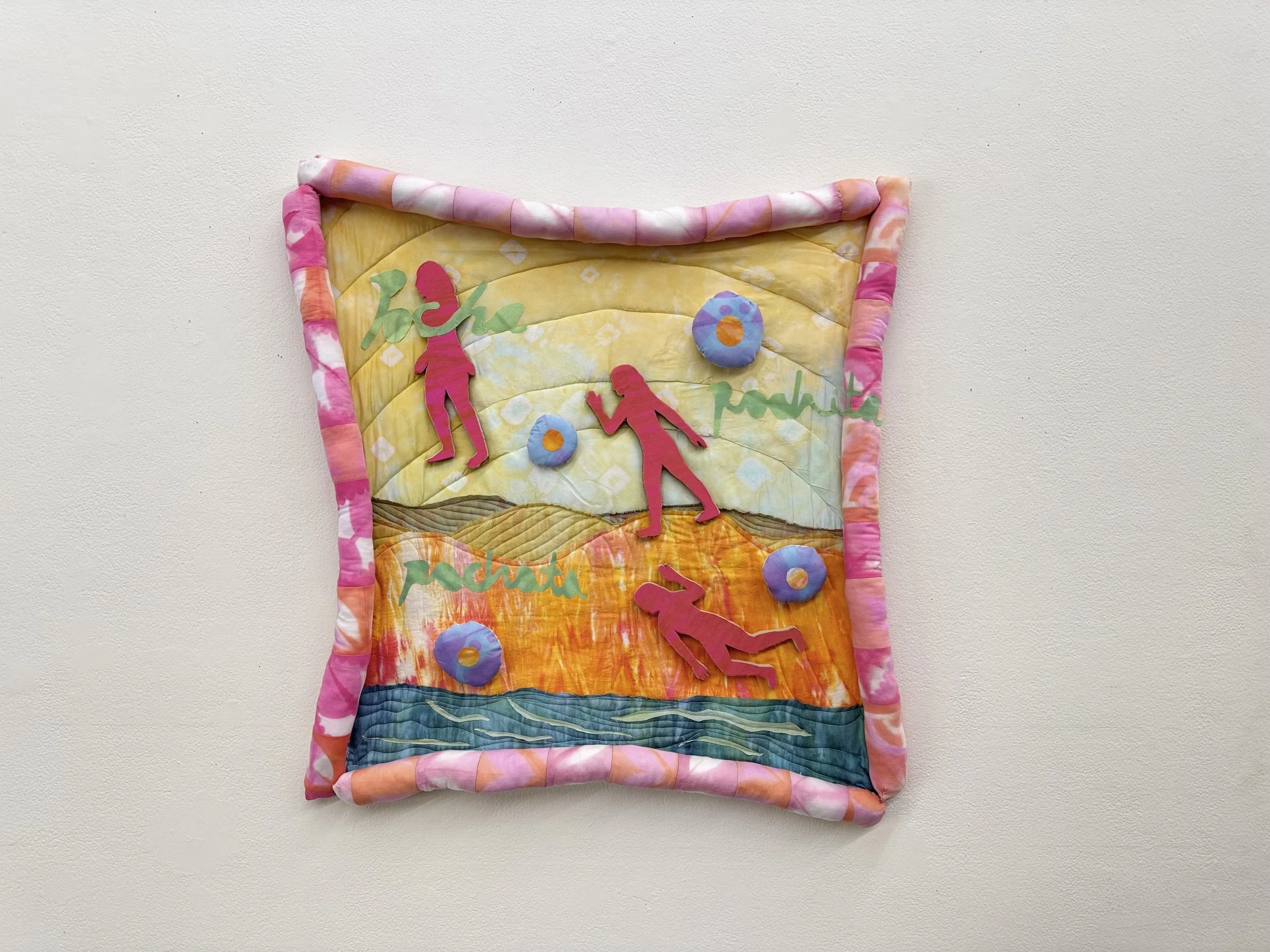
In “Nos Vemos Despúes,” I created a world that falls in between both of my homes. Coming from a multicultural household, I have grown up with two different ideas of home from two different countries. Here I use dream-like visions from a hypnosis therapy experience to create a home that meets both worlds. Landscapes are a recurring vision within my practice that I believe represents an anchorpoint in my identity. I am depicting the land my ancestors walked on which I have never physically experienced but feel pulled towards.
Did the process behind this piece come naturally? What’s an aspect you put a lot of thought towards?
This piece began in my dyeing class when I was learning to use Japanese techniques like shibori. I wanted to explore pattern making with synthetic dye to create artificial, bright colors to represent a vision I had in a dream.
Creating the scene came to me surprisingly easily. The scene and colors came to me right away. I saw it so clearly and my drawn thumbnail looks almost exactly like what I created. But because this was one of my first dyeing projects, I was very quickly humbled. With dyes taking about 45 minutes to soak into the fabric, I was faced with a different way of creating art. The process was challenging and I wanted to put a lot of time into mastering the color palette, so I took a step back from working on primarily conceptual art and focused on becoming more comfortable with techniques.
Is this piece similar to what you’ve made in the past? How do your materials reflect the place you were representing?
I keep finding myself coming back to storytelling through fabric, primarily quilting. Not only do I love how my piece can be activated with touch, but the act of creating is very important to me. I learned to sew at the age of nine, when my Mexican grandmother came to visit us for the first time in years. Looking back, I value that time she spent sitting down with me, teaching me what she was so educated in. Now, using the knowledge she gave me, I relive that moment every time I sew.
Do you see a place differently after making art inspired by it?
I definitely see place differently after making art inspired by it. Experiencing hypnosis therapy, I only saw the landscape in my mind which was mostly influenced by feelings. But being able to put those feelings onto something physical that I can see, it felt nostalgic. The landscape of “Nos Vemos Despúes” isn’t a place I would ever visit, at least not physically. But being able to see it in an artwork, knowing I was its creator, feels important.
Nos Vemos Despúes
Manola Silva-Hanson | Homing
Manola Silva-Hanson is a multi-disciplinary artist currently based in Kansas City, Missouri studying fiber. She focuses on themes of coming from a multi generational household and assimilation seen through generations. She also is inspired by land that we are connected to through ancestors and history. Manola uses a sculptural approach to traditional mediums like sewing, quilting, dyeing, or painting, combining her history to her modern presence as a Mexican-American.
Why does this piece mean ‘homing’ to you? How does it resemble your relationship to place?
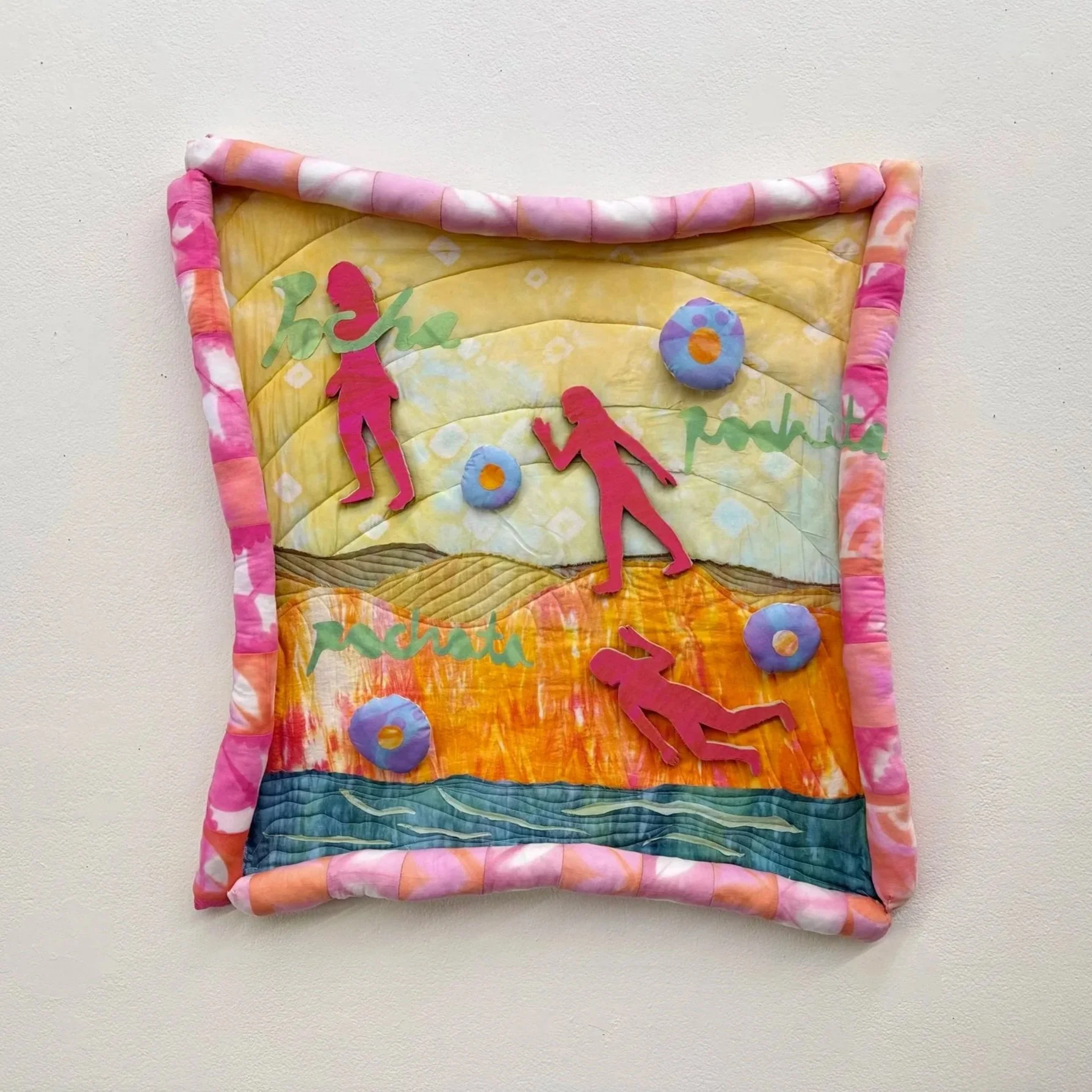
In “Nos Vemos Despúes,” I created a world that falls in between both of my homes. Coming from a multicultural household, I have grown up with two different ideas of home from two different countries. Here I use dream-like visions from a hypnosis therapy experience to create a home that meets both worlds. Landscapes are a recurring vision within my practice that I believe represents an anchorpoint in my identity. I am depicting the land my ancestors walked on which I have never physically experienced but feel pulled towards.
Did the process behind this piece come naturally? What’s an aspect you put a lot of thought towards?
This piece began in my dyeing class when I was learning to use Japanese techniques like shibori. I wanted to explore pattern making with synthetic dye to create artificial, bright colors to represent a vision I had in a dream.
Creating the scene came to me surprisingly easily. The scene and colors came to me right away. I saw it so clearly and my drawn thumbnail looks almost exactly like what I created. But because this was one of my first dyeing projects, I was very quickly humbled. With dyes taking about 45 minutes to soak into the fabric, I was faced with a different way of creating art. The process was challenging and I wanted to put a lot of time into mastering the color palette, so I took a step back from working on primarily conceptual art and focused on becoming more comfortable with techniques.
Is this piece similar to what you’ve made in the past? How do your materials reflect the place you were representing?
I keep finding myself coming back to storytelling through fabric, primarily quilting. Not only do I love how my piece can be activated with touch, but the act of creating is very important to me. I learned to sew at the age of nine, when my Mexican grandmother came to visit us for the first time in years. Looking back, I value that time she spent sitting down with me, teaching me what she was so educated in. Now, using the knowledge she gave me, I relive that moment every time I sew.
Do you see a place differently after making art inspired by it?
I definitely see place differently after making art inspired by it. Experiencing hypnosis therapy, I only saw the landscape in my mind which was mostly influenced by feelings. But being able to put those feelings onto something physical that I can see, it felt nostalgic. The landscape of “Nos Vemos Despúes” isn’t a place I would ever visit, at least not physically. But being able to see it in an artwork, knowing I was its creator, feels important.